

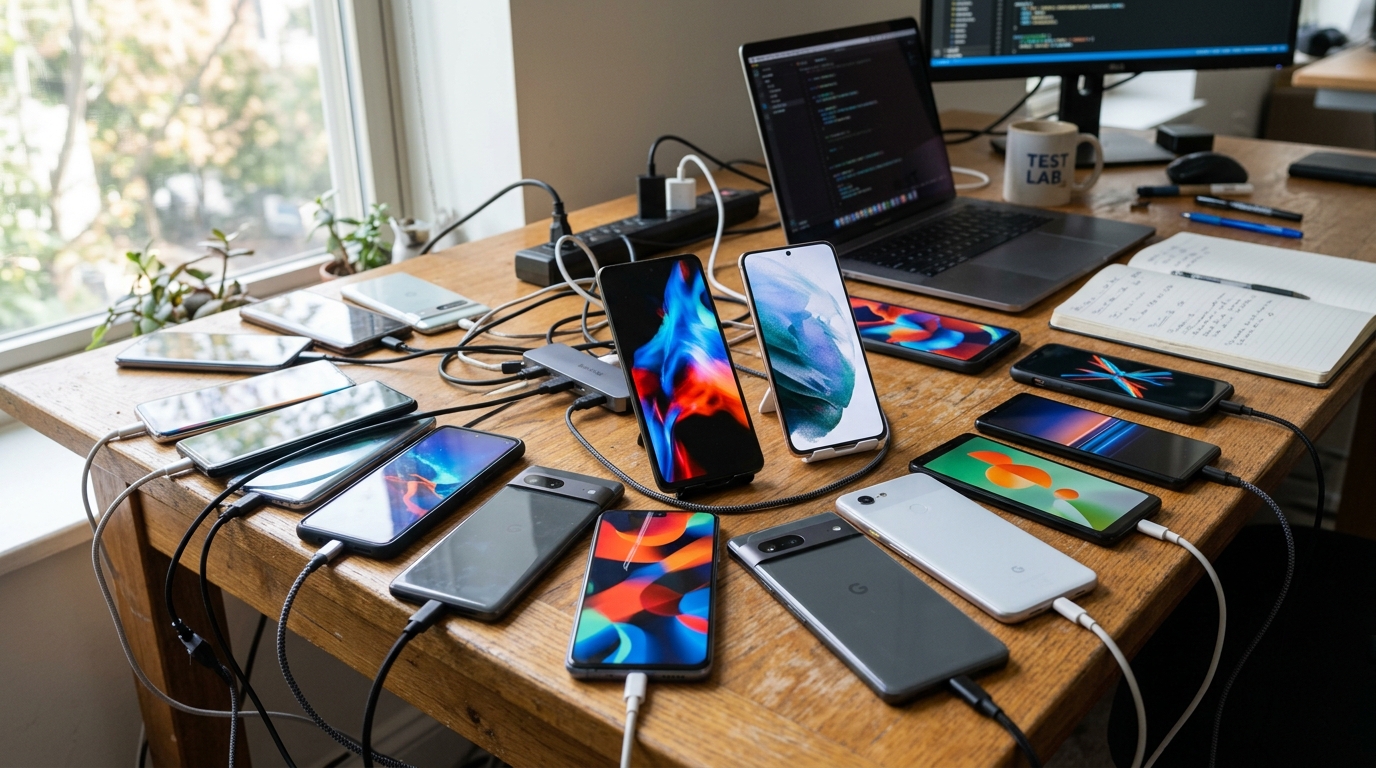
Just last week, I was running stress tests on a new temporal consistency model for video generation. My desk looked like a hardware museum: an iPhone 11 rendering a low-res pre-visualization draft on the left, an iPhone 14 Pro compiling a near-final 4K output on the right, and an iPhone 14 Plus handling background upscaling tasks in the center. The modern mobile AI studio is no longer just a lightweight editing bay; it is a full-fledged production environment where localized machine learning models handle tasks that previously required remote rendering farms. As a research engineer working on image and video generation at AI App Studio, I spend my days figuring out how to shrink massive computing pipelines into apps that fit in your pocket.
The transition happening in creative production right now is entirely structural. In 2025, enterprise AI video adoption grew by 127%, driven largely by a 91% drop in production costs and timelines that collapsed from days to minutes, according to the recent Creative Trends Report by LTX Studio. But the most interesting part of this shift isn't just that the tools are faster. It is that the hardware required to run them has fundamentally changed.
Hardware constraints force better software design
When our technology-focused studio sits down to map out a new product architecture, we have to assume a highly fragmented device ecosystem. It is easy to build software that runs beautifully on a controlled, top-tier desktop environment. It is much harder to engineer software that develops complex localized video outputs on a device that is simultaneously managing battery life, thermal throttling, and background tasks.
We build mobile applications with artificial intelligence at their core, which means we are constantly fighting for compute resources. The neural engine in an older device like the iPhone 11 was built primarily for computational photography—adjusting lighting and parsing faces. Asking it to run a localized diffusion model requires aggressive quantization and memory management. Conversely, the A16 chip in an iPhone 14 Pro gives us significant breathing room to run concurrent models, allowing a user to generate audio-driven video while a separate model refines the visual output in real time.
This hardware reality dictates our entire approach to product development. Doruk Avcı detailed this extensively in his article on how a technology-focused app studio builds a product roadmap, emphasizing that technical feasibility must anchor user expectations. If a brand manager is on a location scout using an iPhone 14 Plus with its larger screen to generate synthetic ad tests, they don't care about the underlying tensor operations. They just want the render to finish before they lose cellular service.
Creative control requires human curation
There is a prevailing assumption that generative models will automate the entire production pipeline. In practice, the opposite is happening. Output generation is cheap; curation and human judgment are becoming the expensive premiums. Market analysis of 2026 design trends highlights a massive shift in production environments toward authenticity, human imperfection, and emotional connection, even as advanced technology becomes deeply embedded in the process.
We see this daily in the way users interact with our image generation pipelines. The creative director's role has evolved. Visual judgment and storytelling remain essential, but prompting and output curation are now core daily skills. The teams moving fastest in 2026 are those who clearly define where the model provides the most utility and where human judgment still leads.
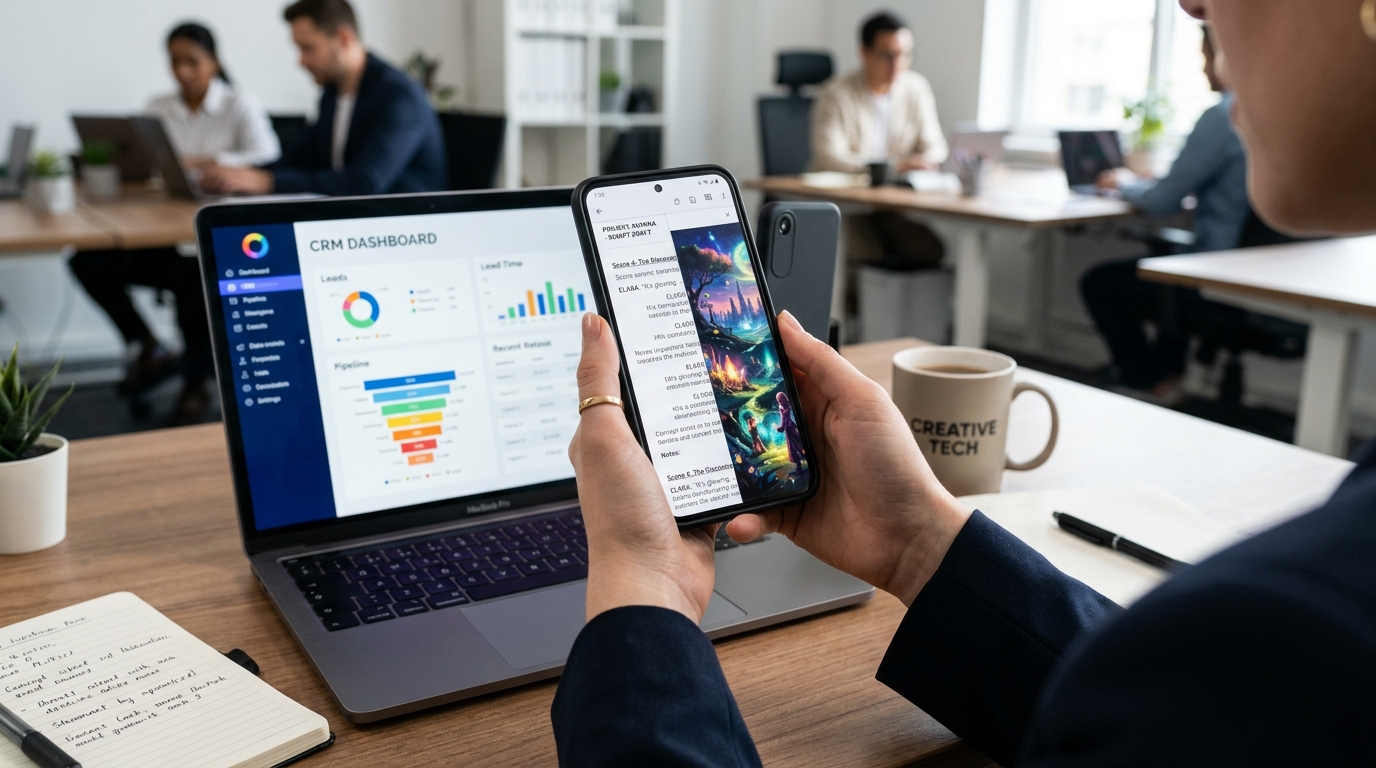
This human-in-the-loop requirement is why mobile interfaces are so critical. A producer might review a synthetic pre-visualization on their phone while commuting. They might pull client feedback from their CRM, cross-reference the original script in a mobile PDF editor, and then use our app to tweak the prompt and re-render the scene. The creative process is no longer confined to a desk; it happens in the friction points of the day.
Efficiency drives the new intellectual property battleground
The economic pressures on larger entertainment and brand studios are trickling down to individual creators. Box office revenues are projected to climb 15% year-over-year according to PwC data, but that growth is hard-won. A recent Variety survey reported that over 70% of major Hollywood studios now use AI for script analysis, pre-visualization, and de-aging effects in early 2026. They are using these tools to handle rote tasks, which has contributed to a 12% uptick in original IP greenlights.
We are building for this exact momentum, just on a different scale. The global demand for these capabilities is expanding rapidly. The 2026 Global Artificial Intelligence Studio Market report tracks this growth across dozens of countries, projecting massive expansion through 2032. The tools that major studios use to pre-visualize a blockbuster are conceptually the same tools a mid-sized marketing agency uses to storyboard a commercial.
Efe Yılmazer covered this topic in detail in his recent piece debunking mobile AI myths, pointing out how thoughtful model integration is replacing heavy workflows with agile, pocket-sized solutions. The goal is not to replace the high-end production house, but to give the director, the marketer, and the creator the ability to test, fail, and iterate at zero marginal cost.
Practical deployment matters more than theoretical benchmarks
When I review research papers on new generation techniques, the benchmarks are almost always based on massive server clusters. My job is to translate those academic benchmarks into a functional reality for someone holding a three-year-old smartphone.
We use a specific decision framework when evaluating which models to integrate into our production environments:
First, we assess the edge-capability. Can this model be quantized to run locally, or does it require a constant API connection? If it requires the cloud, the latency must be low enough that the user doesn't abandon the session.
Second, we evaluate the failure state. When a localized model struggles with a complex prompt, does it crash the application, or does it degrade gracefully, offering a lower-resolution output that the user can still use for conceptual validation?
Third, we look at the interoperability. A generated asset is rarely the final stop. It needs to be exported, shared, or imported into other systems. If a user cannot easily move their generated video file into their team's shared drive or client presentation, the generation itself is practically useless.
The future of creative production isn't going to be defined solely by the size of the parameter count. It will be defined by accessibility. By focusing on how these technologies run in the real world—on the devices people actually carry—we are turning everyday hardware into engines of original thought. The rendering farm has shrunk, and it now fits in your pocket.